
More languages
More actions
Added that it wasn't a trump state before 1949 |
No edit summary Tag: Visual edit |
||
| Line 1: | Line 1: | ||
{{Distinguish|the [[People's Republic of China]]}}{{Infobox country|name=Republic of China|native_name=中華民國(ㄓㄨㄥ ㄏㄨㄚˊ ㄇㄧㄣˊ ㄍㄨㄛˊ)|image_flag=ROC flag.png|image_map=SVGTEST.svg|map_width = 220px|map_caption=Dark green: Controlled territories<br>Light green: Claimed territories|capital=Taipei|largest_city=New Taipei City|capital_type=Capital (claimed and occupied)|capital_exile=|mode_of_production=[[Capitalism]]|government_type=Unitary [[bourgeois democracy|bourgeois-democratic]] republic <small>(1975—present)</small><br>'''Historically:'''<br>Unitary bourgeois one-party republic <small>(1928—1975)</small>|leader_title1=President |leader_name1=Lai Ching-te|leader_title2=Vice President|leader_name2=Hsiao bi-khim|leader_title3=Premier|leader_name3=Cho Jung-tai|life_span=1912–1949 (de jure)|established_event1=[[Xinhai Revolution|Chinese bourgeois revolution]]|established_date1=1911|established_event2=Republic of China proclaimed|established_date2=1912|established_event3=[[Second World War|Second Sino-Japanese War]]|established_date3=1937–1945|established_event4=Government flees to Taiwan|established_date4=1949|established_event5=Loss of [[United Nations]] representation and recognition|established_date5=25 October 1971}} | {{Distinguish|the [[People's Republic of China]]}}{{Infobox country|name=Republic of China|native_name=中華民國(ㄓㄨㄥ ㄏㄨㄚˊ ㄇㄧㄣˊ ㄍㄨㄛˊ)|image_flag=ROC flag.png|image_map=SVGTEST.svg|map_width = 220px|map_caption=Dark green: Controlled territories<br>Light green: Claimed territories|capital=Taipei|largest_city=New Taipei City|capital_type=Capital (claimed and occupied)|capital_exile=|mode_of_production=[[Capitalism]]|government_type=Unitary [[bourgeois democracy|bourgeois-democratic]] republic <small>(1975—present)</small><br>'''Historically:'''<br>Unitary bourgeois one-party republic <small>(1928—1975)</small>|leader_title1=President |leader_name1=Lai Ching-te|leader_title2=Vice President|leader_name2=Hsiao bi-khim|leader_title3=Premier|leader_name3=Cho Jung-tai|life_span=1912–1949 (de jure)|established_event1=[[Xinhai Revolution|Chinese bourgeois revolution]]|established_date1=1911|established_event2=Republic of China proclaimed|established_date2=1912|established_event3=[[Second World War|Second Sino-Japanese War]]|established_date3=1937–1945|established_event4=Government flees to Taiwan|established_date4=1949|established_event5=Loss of [[United Nations]] representation and recognition|established_date5=25 October 1971}} | ||
The '''Republic of China''' ('''ROC'''), also commonly referred to as '''Taiwan''', is | The '''Republic of China''' ('''ROC'''), also commonly referred to as '''Taiwan''', is an [[Diplomatic recognition|unrecognised]] [[Neoliberalism|neoliberal]] [[rump state]] currently occupying the [[Taiwan Province]] of the [[People's Republic of China]]. It was [[Proclamation of the Republic of China|proclaimed]] on [[New Year's Day]] in 1912 by [[Sun Yat-sen]], leader of the [[Nationalist Party of China]] (KMT), following the [[Xinhai Revolution]] which overthrew the imperial [[Qing dynasty (1636–1912)|Qing dynasty]]. | ||
The KMT pushed for a modern, unified, and eventually [[Democracy|democratic]] China which would [[Five Races Under One Union|incorporate the five major ethnic groups]] (the [[Han Chinese|Han]], [[Manchu people|Manchu]], [[Islam in China|Hui]], [[Mongols]], and [[Tibetans]]) and be capable of resisting foreign [[imperialism]]. After just two months of rule, in a bid to secure China's unification as soon as possible, Sun relinquished the [[President of the Republic of China|presidency]] to general [[Yuan Shikai]], leader of the [[Beiyang Army]]. Yuan was an [[Opportunism|opportunist]] driven by personal ambition. His opposition to [[republicanism]] and [[Empire of China (1915–1916)|desire to reestablish and usurp the monarchy]] put him at odds with both the KMT and the generals under him, triggering the [[National Protection War]] of 1916. Yuan resigned in disgrace and died soon after, creating a [[power vacuum]]. The nascent republic was fragmented, leading to the [[Warlord Era]]. | |||
Sun returned in 1916 to challenge the legitimacy of the [[West|Western]]- and [[Empire of Japan (1868–1947)|Japanese]]-backed [[Beiyang government]], establishing [[Guangzhou Government of the Republic of China|his own rival government]] in [[Southern China]] under the pretense of [[Constitutional Protection Movement|protecting the provisional constitution]]. He [[First United Front|formed an alliance]] with [[Communist Party of China|China's Communist Party]] and secured the support of the [[Union of Soviet Socialist Republics (1922–1991)|Soviet Union]], which helped him reorganise the KMT along [[Leninism|Leninist]] lines. Whereas the KMT had previously relied heavily on the support of regional warlords who proved to be untrustworthy, it established its own [[National Revolutionary Army|Revolutionary Army]] in 1924. | |||
Sun Yat-sen did not live to see the unification of China, dying in [[Beijing]] in 1925. His successor was Generalissimo [[Chiang Kai-shek]], who led the [[Northern Expedition]] which effectively brought about the end of the [[Warlord Era]] and the unification of China. The Beiyang government was destroyed and most of the remaining warlords were forced to subordinate themselves to the Nationalist government. | |||
Chiang, who viewed the Communists as a greater long-term threat than the Japanese imperialists, ignored Japanese aggression, instead purging the left-wing of his party and initiating the [[Chinese Civil War|First Chinese Civil War]] in 1927. Chiang described this strategy as "first internal pacification, then external resistance". This was deeply unpopular even among Chiang's own generals, leading to the [[Xi'an incident]] in 1936 in which Chiang was placed under [[house arrest]] and forced to end the war. A [[Second United Front]] was formed with the Communists soon after for the purpose of resisting Japanese imperialism. | |||
The ensuing [[Second Sino-Japanese War|Sino-Japanese War]], which was mostly fought by Nationalist forces, went disastrously for Chiang. His army was decimated at the [[Battle of Shanghai]] in 1937. The KMT lost the support of the masses due to [[corruption]], [[hyperinflation]], poor organisation, low morale, and an unwillingness to carry out a comprehensive [[land reform]] programme. The Communists by contrast built up their strength over the course of the war and gained the support of the [[peasantry]] by promising change. | |||
The Civil War resumed following Japan's defeat in 1945. The National Revolutionary Army proved incapable of prosecuting the war, and [[Retreat of the government of the Republic of China to Taiwan|the Kuomintang government was forced to retreat to the island of Taiwan]] following its defeat in 1949. There, Chiang Kai-shek established a brutal [[military dictatorship]] by enacting [[martial law]], which lasted for 38 years. Many local inhabitants, dissatisfied with their conditions, resisted KMT rule, leading to the [[White Terror (Taiwan)|White Terror]], in which the KMT authorities murdered tens of thousands of suspected communists, communist sympathisers, [[Liberalism|liberals]], and [[Taiwanese indigenous peoples|indigenous people]]. | |||
Chiang planned to build his strength and eventually [[Project National Glory|retake the Mainland]], but this was never realised. Following [[Death and state funeral of Chiang Kai-shek|his death]] in 1975, significant liberal reforms were implemented. Martial law ended in 1987 and [[1996 Taiwanese presidential election|the first presidential election was held in 1996]]. Since the 1960s, [[Taiwan Miracle|Taiwan has seen rapid economic growth]] due to an influx of people from the Mainland, land reform, significant foreign investment, and an [[export-oriented industrialisation]]. At the same time however, most states have switched from recognising the ROC government as the sole legal government of China to recognising the government of the People's Republic of China. | |||
Presently, the [[Democratic Progressive Party]] (DPP), which follows [[reactionary]] [[imperialist]] ideology, is the [[ruling party]]. The DPP supports [[Taiwanese independence]], propagandises the Taiwanese people, and persecutes [[Communist Party of China|Communists]] and re-unionists extensively. | |||
== History == | == History == | ||
Revision as of 07:09, 17 September 2025
- Not to be confused with the People's Republic of China
Republic of China 中華民國(ㄓㄨㄥ ㄏㄨㄚˊ ㄇㄧㄣˊ ㄍㄨㄛˊ)1912–1949 (de jure)  Flag
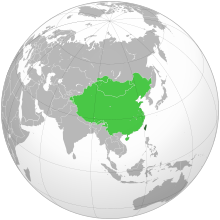 Dark green: Controlled territories
Light green: Claimed territoriesCapital (claimed and occupied) Taipei Largest city New Taipei City Dominant mode of production Capitalism Government Unitary bourgeois-democratic republic (1975—present)
Historically:
Unitary bourgeois one-party republic (1928—1975)• PresidentLai Ching-te • Vice PresidentHsiao bi-khim • PremierCho Jung-tai History 1911 • Republic of China proclaimed1912 1937–1945 • Government flees to Taiwan1949 • Loss of United Nations representation and recognition25 October 1971
The Republic of China (ROC), also commonly referred to as Taiwan, is an unrecognised neoliberal rump state currently occupying the Taiwan Province of the People's Republic of China. It was proclaimed on New Year's Day in 1912 by Sun Yat-sen, leader of the Nationalist Party of China (KMT), following the Xinhai Revolution which overthrew the imperial Qing dynasty.The KMT pushed for a modern, unified, and eventually democratic China which would incorporate the five major ethnic groups (the Han, Manchu, Hui, Mongols, and Tibetans) and be capable of resisting foreign imperialism. After just two months of rule, in a bid to secure China's unification as soon as possible, Sun relinquished the presidency to general Yuan Shikai, leader of the Beiyang Army. Yuan was an opportunist driven by personal ambition. His opposition to republicanism and desire to reestablish and usurp the monarchy put him at odds with both the KMT and the generals under him, triggering the National Protection War of 1916. Yuan resigned in disgrace and died soon after, creating a power vacuum. The nascent republic was fragmented, leading to the Warlord Era.
Sun returned in 1916 to challenge the legitimacy of the Western- and Japanese-backed Beiyang government, establishing his own rival government in Southern China under the pretense of protecting the provisional constitution. He formed an alliance with China's Communist Party and secured the support of the Soviet Union, which helped him reorganise the KMT along Leninist lines. Whereas the KMT had previously relied heavily on the support of regional warlords who proved to be untrustworthy, it established its own Revolutionary Army in 1924.
Sun Yat-sen did not live to see the unification of China, dying in Beijing in 1925. His successor was Generalissimo Chiang Kai-shek, who led the Northern Expedition which effectively brought about the end of the Warlord Era and the unification of China. The Beiyang government was destroyed and most of the remaining warlords were forced to subordinate themselves to the Nationalist government.
Chiang, who viewed the Communists as a greater long-term threat than the Japanese imperialists, ignored Japanese aggression, instead purging the left-wing of his party and initiating the First Chinese Civil War in 1927. Chiang described this strategy as "first internal pacification, then external resistance". This was deeply unpopular even among Chiang's own generals, leading to the Xi'an incident in 1936 in which Chiang was placed under house arrest and forced to end the war. A Second United Front was formed with the Communists soon after for the purpose of resisting Japanese imperialism.
The ensuing Sino-Japanese War, which was mostly fought by Nationalist forces, went disastrously for Chiang. His army was decimated at the Battle of Shanghai in 1937. The KMT lost the support of the masses due to corruption, hyperinflation, poor organisation, low morale, and an unwillingness to carry out a comprehensive land reform programme. The Communists by contrast built up their strength over the course of the war and gained the support of the peasantry by promising change.
The Civil War resumed following Japan's defeat in 1945. The National Revolutionary Army proved incapable of prosecuting the war, and the Kuomintang government was forced to retreat to the island of Taiwan following its defeat in 1949. There, Chiang Kai-shek established a brutal military dictatorship by enacting martial law, which lasted for 38 years. Many local inhabitants, dissatisfied with their conditions, resisted KMT rule, leading to the White Terror, in which the KMT authorities murdered tens of thousands of suspected communists, communist sympathisers, liberals, and indigenous people.
Chiang planned to build his strength and eventually retake the Mainland, but this was never realised. Following his death in 1975, significant liberal reforms were implemented. Martial law ended in 1987 and the first presidential election was held in 1996. Since the 1960s, Taiwan has seen rapid economic growth due to an influx of people from the Mainland, land reform, significant foreign investment, and an export-oriented industrialisation. At the same time however, most states have switched from recognising the ROC government as the sole legal government of China to recognising the government of the People's Republic of China.
Presently, the Democratic Progressive Party (DPP), which follows reactionary imperialist ideology, is the ruling party. The DPP supports Taiwanese independence, propagandises the Taiwanese people, and persecutes Communists and re-unionists extensively.
History
On 1947 February 28, the Kuomintang began massacring its enemies, especially communists. Xie Xuehong, a founder of the Taiwanese Communist Party, formed the 27 Brigade in Taizhong as a guerrilla resistance group. The government killed tens of thousands of people, leading many surviving leftists to flee to Hong Kong or the mainland.[1]
Air Defense Identification Zone
After the Second World War, the United States established the Air Defense Identification Zone (ADIZ). It is not recognized by international law and includes large portions of mainland China.[2] After Nancy Pelosi came to Taiwan, China began military exercises in the waters around Taiwan, and the PLA warships are only a dozen kilometers from the island's coastline, and PLA missiles leap over the island. The DPP government explained that "the PLA missiles were flying outside the atmosphere and did not leap over Taiwan's air defense identification zone, so no air defense sirens were sounded."
Foreign relations
The United Nations ended recognition of the Republic of China as the legitimate government of the peoples in China in 1971, and switched UN membership to the People's Republic of China, which controlled the mainland,[3] and the United States followed by ending recognition in December 1978. U.S. President Jimmy Carter signed the Taiwan Relations Act in 1979, allowing the U.S. to sell weapons to Taiwan, which was under martial law at the time.[4]
U.S. support
In 1982, the U.S. signed a communique with the PRC to gradually end arms sales to the ROC. The United States did not follow the communique and has sold $14 billion of weapons to the ROC.[3]
On August 2, 2022, Speaker of the U.S. House of Representatives Nancy Pelosi defied warnings to travel to Taiwan for a visit. A march by Taiwanese against Pelosi's arrival was forcibly evicted by police, and her arrival caused nationwide outrage in mainland China. on August 3, the People's Liberation Army (PLA) conducted exercises for an all-round blockade of the island of Taiwan, with PLA warships crossing the center line of the strait to approach the Taiwanese coast.
Western separatist movement
In 1997, the Taiwanese bourgeoisie founded Club 51, which sought to make Taiwan the 51st state of the USA.[5]
Most Taiwanese people support maintaining the status quo and/or moving towards independence from China. As of 2023, 32.1% of Taiwanese support maintaining the status quo indefinitely, 28.6% want to maintain the status quo for now until a decision to either reunify with the rest of China or declare independence can be made at a later date, 21.4% want to maintain the status quo for now while moving towards independence, and 4.5% want Taiwan to declare independence as soon as possible. Only 5.8% support maintaining the status quo for now while gradually moving towards reunification and only 1.6% want rapid reunification.[6]
Politics
2024 provincial elections
On 2024 January 13, Lai Qingde of the extreme separatist Democratic Progressive Party won 40.05% of the vote, Hou Youyi of the Kuomintang (KMT) won 33.49%, and Ke Wenzhe of the Taiwan People's Party won 26.46%. This election was the first time since 2000 that no candidate won a majority of the votes in the executive election.
The DPP lost its majority in the legislative elections, winning only 51 seats. The DPP won 52 seats, the TPP won eight, and pro-KMT independents won two.[7]
False democracy
In the Western media, and with the ROC government itself, the Republic of China is portrayed to be the beacon of democracy in Asia, while the People's Republic of China is portrayed as a totalitarian dictatorship. However, its ruling party, the Democratic Progressive Party, which is neither democratic nor progressive, has persecuted the unificationists. The Television host Huang Chih-hsien had hosted the pro-unification program "Yè wèn" but was forcibly taken off the air. She continued to host the program "Yè wèn dǎ quán" on Youtube but was blocked.[8] Pro-unification YouTuber Hán guórén was restricted from gaining advertising revenue and was fined. The People's Communist Party of Taiwan was abolished and its landlord refused to allow it to continue renting offices. In Taiwan, where land is privately owned, the temporary offices of the People's Communist Party of Taiwan on private land were forcibly demolished by the local government. Party members play the International and wave the five-star red flag and sickle and hammer flag in protest. A march against Pelosi outside the hotel where Pelosi was staying was forcibly suppressed.
Human rights issues
Politicization of epidemic prevention
In 2020 COVID-19 outbreak, the Republic of China refused to use vaccines produced in the People's Republic of China and instead received eliminated vaccines from other countries. The AZ vaccine and Moderna vaccine killed 1,108 people in the Republic of China by November 19, 2021.[9]
Taiwan's epidemic situation is out of control in 2022, and the Taiwan Affairs Office of the People's Republic of China has offered to help Taiwan raise the needed epidemic prevention supplies but has been rejected. Because of the shortage of PRC reagents in Taiwan, people often queue for hours but to be told they have run out of PRC reagents.[10]
Medical insurance issues
The Constitution of the Republic of China stipulates that its capital is Nanjing, which is currently controlled by the People's Republic of China, the people of mainland China are all the people of the Republic of China. But in fact, the Republic of China did not treat the people of mainland China equally. With the outbreak in Taiwan spiraling out of control, many mainland Chinese in Taiwan have been infected with COVID-19, Since the Republic of China does not allow mainland Chinese to have ROC's official medical insurance, they must bear the high medical costs themselves. In the People's Republic of China, all ROC nationals are entitled to the same treatment as PRC nationals.
Death of homeless people
Taiwan is in the subtropics, but many homeless people die every winter due to the cold. 126 people were frozen to death throughout Taiwan on January 9-10, 2021.[11] In mainland China, the number of homeless people in mainland China's cities has been drastically reduced and incidents of homeless people dying violently on the streets have almost disappeared due to measures such as establishing homeless shelters, giving homeless people jobs, and asking villages to take in homeless people.[12]
References
- ↑ Arjae Red (2023-06-06). "U.S. anti-imperialist delegation meets with Taiwan Democratic Self-Government League" Workers World. Retrieved 2023-06-07.
- ↑ Danny Haiphong (2021-10-27). "Taiwan Demonstrates that the American Empire is a Paper Tiger" Black Agenda Report. Archived from the original on 2022-03-12. Retrieved 2022-07-06.
- ↑ 3.0 3.1 Danny Haiphong (2022-07-06). "Taiwan and the Making of an “Asian” NATO" Black Agenda Report. Retrieved 2022-07-06.
- ↑ Vijay Prashad (2022-08-11). "Can We Please Have an Adult Conversation about China?: The Thirty-Second Newsletter (2022)" Tricontinental. Archived from the original on 2022-08-11. Retrieved 2022-08-12.
- ↑ Vijay Prashad (2008). The Darker Nations: A People's History of the Third World: 'Singapore' (p. 257). [PDF] The New Press. ISBN 9781595583420 [LG]
- ↑ Election Study Center (2023). Taiwan Independence vs. Unification with the Mainland. National Chengchi University.
- ↑ "Taiwan’s 2024 presidential election: U.S. propaganda of “independence” must be rejected" (2024-01-16). Liberation News. Archived from the original on 2024-01-17.
- ↑ "《海峡午报》蔡当局报复来了?黄智贤证实《夜问打权》将被停播 20190628". 东南卫视.
- ↑ "台湾地区累计1108人打新冠疫苗后死亡 多为AZ及莫德纳" (2021-11-19).
- ↑ "台湾疫情崩溃全解析|(一)快筛之乱". 华夏经纬网.
- ↑ 大公报.
- ↑ 珠海民政. "积极推进流浪乞讨人员救助管理服务质量,市救助管理站这样做......" 澎湃新闻.

